

Cancer Care
Cancer Care

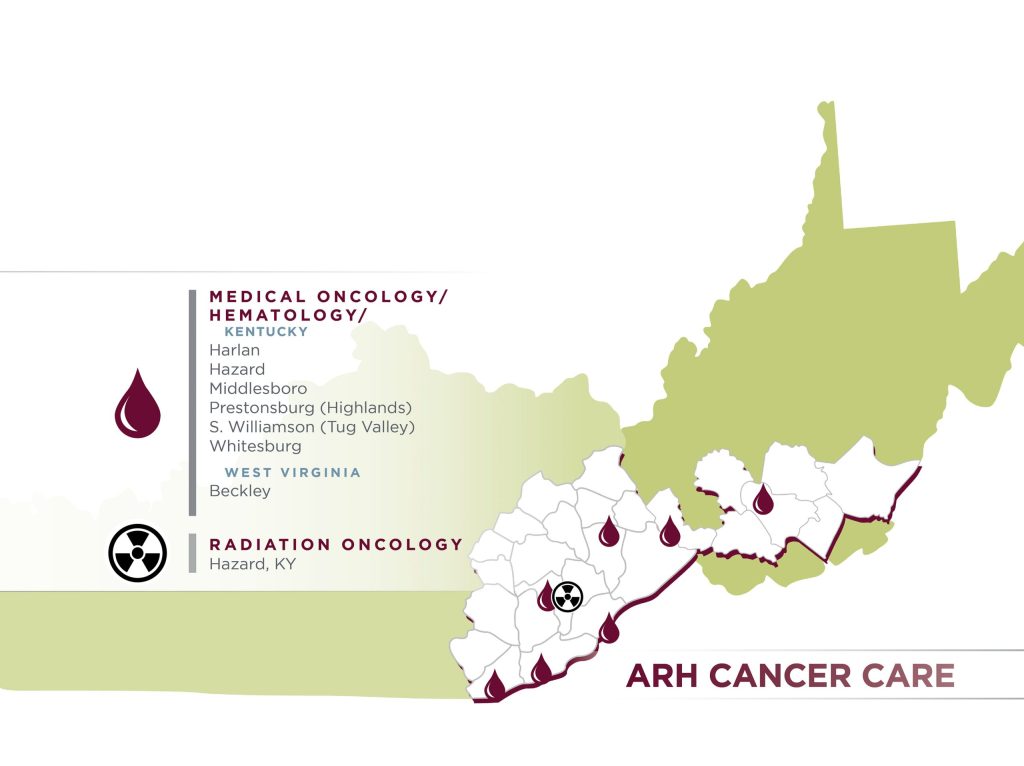
The story of ARH is one that is deeply rooted in the dedication to serving the people of Central Appalachia. We are a healthcare system committed to assisting you through every stage of your cancer journey or living with your blood disorder. ARH has a team of providers who specialize in medical oncology, radiation oncology, and surgical oncology that work alongside a staff of highly qualified oncology nurses, social workers, pathologists, and radiologists. Collaboration is a vital part of our approach to excellent care. Cancer cases are reviewed by a board of ARH Oncologists, that reaches throughout our entire system. Receiving input from multiple providers is an important part of what we do to make sure all options are explored, and you have the best possible treatment plan. Our staff’s expertise, combined with advanced technology, and state of the art Oncology centers provide our patients with the highest quality care.
WHAT WE TREAT
(including but not limited to)
- Blood Disorders, such as anemia & hemochromatosis
- Cancers
- Chronic Leukemia (Blood Cell Cancer)
- Colon Cancer
- Gynecological Cancers
- Lymphoma (Lymphatic System Cancer)
- Multiple Myeloma (Plasma Cell Cancer)
- Myelodysplasia (Bone Marrow Disorder)
- Breast Cancer
LOW DOSE-CT LUNG CANCER SCREENING
Lung Cancer is the leading cause of cancer death among men and women in the U.S. But, did you know there is a simple screening, like those used to detect breast cancer and colon cancer, to detect Lung Cancer? ARH offers Low-Dose CT lung screenings. This test is performed by a CT scanner that takes 3D pictures of your lungs. Currently a LOW-Dose CT Lung screening is the only screening test for lung cancer recommended by the CDC. Talk to your primary care provider about getting a Low Dose CT lung screening or contact our ARH Lung Screening Navigator at 606-435-7209 to verify your eligibility. Lung Cancer found at its earliest stage can have up to a 90% chance of cure. With early detection we can save lives.
WANT TO SEE IF YOU QUALIFY? CLICK THE LINK BELOW TO CHECK YOUR ELIGIBILITY!
ION BIOPSY
According to the American Lung Association’s 2023 “State of Lung Cancer” report, Kentucky has a higher rate of new lung cancer cases than the national average, but lower rates of survival and early diagnosis.
At Hazard ARH Regional Medical Center, we recognize the critical importance of early detection in lung cancer, which is why we offer comprehensive services starting with screenings using low-dose CT scans. If a spot or small growth in your lung, called lung nodules, is detected on the CT scan, a bronchoscopy is needed to biopsy them. Hazard ARH is the first and only hospital in eastern Kentucky with the newest technology for bronchoscopy, called Ion Robotic Bronchoscopy.
Dr. Ashley Thompson, a triple board-certified pulmonologist at ARH, has undergone extensive training to perform bronchoscopy using the Ion robotic system. Dr. Thompson uses the Ion controller to guide a flexible catheter into hard-to-reach areas of the lung. The procedure provides a 3-D map of the patient’s lung on a monitor, similar to a car GPS, allowing her to navigate the catheter effectively. The catheter’s flexibility enables it to reach even the outermost lung segments. Once positioned, biopsy tools are inserted through the catheter to collect tissue samples.
Benefits
- It can reach and biopsy nodules in all 18 parts of the lung.
- Earlier detection of lung cancer due to its reach, precision, and stability.
- It’s less invasive than older methods.
- Low complication rates.
CHEMOTHERAPY
When Pineville, Ky. native Amber Bailey, a registered nurse at Barbourville ARH Hospital, learned she had stage four cholangiocarcinoma, she knew she had to fight this terminal cancer for her three children. What Amber didn’t know was her ARH co-workers would form an army to join her in the fight.
Chemotherapy is a drug treatment that uses powerful chemicals to kill fast-growing cells in your body. Chemotherapy is most often used to treat cancer, since cancer cells grow and multiply much more quickly than most cells in the body. Many different chemotherapy drugs are available. Chemotherapy drugs can be used alone or in combination to treat a wide variety of cancers. Though chemotherapy is an effective way to treat many types of cancer, chemotherapy treatment also carries a risk of side effects. Some chemotherapy side effects are mild and treatable, while others can cause serious complications.
Chemotherapy works by stopping or slowing the growth of cancer cells, which grow and divide quickly. But it can also harm healthy cells that divide quickly, such as those that line your mouth and intestines or cause your hair to grow. Damage to healthy cells may cause side effects. Often, side effects get better or go away after chemotherapy is over.
Depending on your type of cancer and how advanced it is, chemotherapy can:
- Cure cancer– when chemotherapy destroys cancer cells to the point that your doctor can no longer detect them in your body and they will not grow back.
- Control cancer– when chemotherapy keeps cancer from spreading, slows its growth, or destroys cancer cells that have spread to other parts of your body.
- Ease cancer symptoms(also called palliative care) – when chemotherapy shrinks tumors that are causing pain or pressure.
Sometimes, chemotherapy is used as the only cancer treatment. But more often, you will get chemotherapy along with surgery, radiation therapy, or >biological therapy. Chemotherapy can:
- Make a tumor smaller before surgery or radiation therapy. This is called neo-adjuvant chemotherapy.
- Destroy cancer cells that may remain after surgery or radiation therapy. This is called >adjuvant chemotherapy.
- Help radiation therapy and biological therapy work better.
- Destroy cancer cells that have come back (>recurrent cancer) or spread to other parts of your body (>metastatic cancer).
This choice depends on:
- The type of cancer you have. Some types of chemotherapy drugs are used for many types of cancer. Other drugs are used for just one or two types of cancer.
- Whether you have had chemotherapy before
- Whether you have other health problems, such as diabetes or heart disease
You may receive chemotherapy during a hospital stay, at home, or in a doctor’s office, clinic, or >outpatient unit in a hospital (which means you do not have to stay overnight). No matter where you go for chemotherapy, your doctor and nurse will watch for side effects and make any needed drug changes.
Treatment schedules for chemotherapy vary widely. How often and how long you get chemotherapy depends on:
- Your type of cancer and how advanced it is
- The goals of treatment (whether chemotherapy is used to cure your cancer, control its growth, or ease the symptoms)
- The type of chemotherapy
- How your body reacts to chemotherapy
You may receive chemotherapy in cycles. A cycle is a period of chemotherapy treatment followed by a period of rest. For instance, you might receive 1 week of chemotherapy followed by 3 weeks of rest. These 4 weeks make up one cycle. The rest period gives your body a chance to build new healthy cells.
It is not good to skip a chemotherapy treatment. But sometimes your doctor or nurse may change your chemotherapy schedule. This can be due to side effects you are having. If this happens, your doctor or nurse will explain what to do and when to start treatment again.
Chemotherapy may be given in many ways.
- Injection. The chemotherapy is given by a shot in a muscle in your arm, thigh, or hip or right under the skin in the fatty part of your arm, leg, or belly.
- Intra-arterial (IA). The chemotherapy goes directly into the artery that is feeding the cancer.
- Intraperitoneal (IP). The chemotherapy goes directly into the >peritoneal cavity (the area that contains organs such as your intestines, stomach, liver, and ovaries).
- Intravenous (IV). The chemotherapy goes directly into a vein.
- Topically. The chemotherapy comes in a cream that you rub onto your skin.
- Orally. The chemotherapy comes in pills, capsules, or liquids that you swallow.
Chemotherapy affects people in different ways. How you feel depends on how healthy you are before treatment, your type of cancer, how advanced it is, the kind of chemotherapy you are getting, and the dose. Doctors and nurses cannot know for certain how you will feel during chemotherapy.Some people do not feel well right after chemotherapy. The most common side effect is >fatigue, feeling exhausted and worn out. You can prepare for fatigue by:
- Asking someone to drive you to and from chemotherapy
- Planning time to rest on the day of and day after chemotherapy
- Getting help with meals and childcare the day of and at least 1 day after chemotherapy
There are many ways you can help manage chemotherapy side effects.
Many people can work during chemotherapy, as long as they match their schedule to how they feel. Whether or not you can work may depend on what kind of work you do. If your job allows, you may want to see if you can work part-time or work from home on days you do not feel well. Many employers are required by law to change your work schedule to meet your needs during cancer treatment. Talk with your employer about ways to adjust your work during chemotherapy. You can learn more about these laws by talking with a social worker.
This depends on the type of chemotherapy you get and the other types of drugs you plan to take. Take only drugs that are approved by your doctor or nurse. Tell your doctor or nurse about all the over-the-counter and prescription drugs you take, including laxatives, allergy medicines, cold medicines, pain relievers, aspirin, and ibuprofen.One way to let your doctor or nurse know about these drugs is by bringing in all your pill bottles. Your doctor or nurse needs to know:
- The name of each drug
- The reason you take it
- How much you take
- How often you take it
Your doctor will give you physical exams and medical tests (such as blood tests and x-rays). He or she will also ask you how you feel.You cannot tell if chemotherapy is working based on its side effects. Some people think that severe side effects mean that chemotherapy is working well. Or that no side effects mean that chemotherapy is not working. The truth is that side effects have nothing to do with how well chemotherapy is fighting your cancer.
Talk to your doctor or nurse before you take any over-the-counter or prescription drugs, vitamins, minerals, dietary supplements, or herbs.
Some of these products can change how chemotherapy works. For this reason, it is important to tell your doctor or nurse about all the vitamins, minerals, dietary supplements, and herbs that you take before you start chemotherapy. During chemotherapy, talk with your doctor before you take any of these products.
HEMATOLOGY
Hematology is the study of blood and blood disorders. Hematologists and hematopathologists are highly trained healthcare providers who specialize in diseases of the blood and blood components. These include blood and bone marrow cells. Hematological tests can help diagnose anemia, infection, hemophilia, blood-clotting disorders, and leukemia.
· Iron Infusion
· Blood Transfusion
· IV Antibiotics
RADIATION ONCOLOGY
Industry leading radiation treatment at ARH
Patients needing radiation are treated with equipment from the most trusted manufacturer in the industry; the Varian TrueBeam Radiation Therapy Linear Accelerator, equipped with On-Board Imaging and 3D Cone-Beam CT for Image-Guided Radiation Therapy (IGRT). This equipment allows the ARH team to align and treat the patient with radiation beams from multiple angles very accurately. This helps focus the required dose to the desired treatment volumes while minimizing dosage to surrounding tissue and organs. ARH also uses the custom-designed Siemens Somatom GoSim CT Therapy Simulator. This machine helps replicate patient position and imaging the same way as they will be treated on the linear accelerator. Varian’s Eclipse treatment planning software uses this information to create and calculate the individualized radiation plans for each patient.
Types of radiation therapy:
- Systemic radiation therapy – uses radioactive drugs (called radiopharmaceuticals or radionuclides) to treat certain types of cancer, including thyroid, bone, and prostate cancer. These are liquid drugs made up of a radioactive substance. They can be given by mouth or put into a vein; they then travel throughout the body.
- Stereotactic body radiation therapy (SBRT) – also called stereotactic ablative radiotherapy (SaBR)) is used to treat tumors outside of the brain and spine. It accurately delivers very high doses of radiation to the tumor in few treatments (one to five) while limiting the impact on nearby healthy tissue.
- Intensity-modulated radiation therapy (IMRT) is highly personalized to the patient’s needs and anatomy. Just like surgery, outcomes from this therapy greatly depend on physician experience and close attention to dose and volumes of the treated tissues. ARH radiation oncologists are highly experienced in IMRT, and they specialize in complex cases, including patients who have had previous radiation therapy or surgeries and those with other complicated medical issues. IMRT is able to protect the normal, healthy tissue and the critical tissues around the tumor so that your physician can deliver a high dose of radiation more precisely to the cancer and minimize side effects from the treatment. IMRT treatments can be used to cure cancer (typically occurring everyday Monday-Friday for six to nine weeks) or to treat symptoms from the cancer (usually shorter in duration, anywhere from once to every day for two to three weeks), also called palliative treatment.
- 3D CRT Conventional/3D-conformal radiation therapy delivers radiation treatments every Monday through Friday, typically for two to six weeks. This type of radiation directs the appropriate dose of radiation to the cancer, while using detailed imaging and block design to spare the surrounding healthy tissue.
- Respiratory Gating – is an innovative process that uses advanced computer software to guide the delivery of radiation as a patient breathes. A tumor can sometimes move during treatment, especially if it is located in an area of the body that naturally moves as a result of respiration, such as lungs, chest, or abdomen.
PATIENT NAVIGATOR PROGRAM
There is more to your cancer journey than doctor’s appointments and treatment options. From family and financial concerns to insurance or employment issues, these stresses drain energy that should be focused on treatment and recovery. With the help of the Patient Navigators at the ARH, we make sure you are not alone during your treatment by providing free assistance including:
- Transportation Assistance – The Cancer Center has established a Patient Assistance Fund and holds regular fundraisers to help patients who need transportation (to and from treatments on a regular basis) or lodging assistance during multiple treatment visits.
- Medication Assistance – Programs are available to assist qualifying patients in filling prescriptions with large co-pays or if the patient has no insurance.
- Financial Assistance – If a patient has no insurance, arrangements can be made to get them enrolled for a Spend Down Card. Patients qualifying for Medicaid or another program can be assisted in the application process. There are also Financial Assistance programs available through Cancer Care and the American Cancer Society.
- Cancer Information – Our Patient Navigator can help patients find valuable information about their particular type of cancer, its treatment and side effects, to help them be as informed as possible during treatment, as well as during survivorship and living with cancer.
- Survivorship – Once your cancer treatment is complete this service can help patients understand the next steps for follow-up care, like regular well-visits and exams. Our Patient Navigators provide resources as well as clinic support to help you during this transition.
LINKS TO LEARN MORE
- UK Markey Cancer Center Affiliate Network: http://ukhealthcare.uky.edu/Markey/affiliates/index.asp
- American Cancer Society: http://www.cancer.org
- Susan G. Komen for the Cure: www.komen.org
- National Cancer Institute: https://www.cancer.gov · CareingBridge.org: https://www.caringbridge.org