


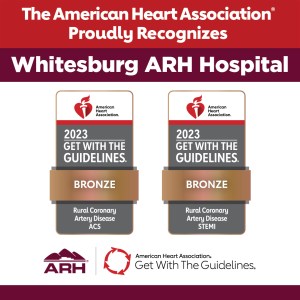
April 11, 2024 — Whitesburg Appalachian Regional Healthcare (ARH) has been awarded for efforts to improve rural care for coronary artery disease. People who live in rural communities live an average of three years fewer than urban counterparts and have a 40% higher likelihood of developing heart disease.1,2 Whitesburg ARH is committed to changing that.
For efforts to optimize acute cardiac care and eliminate rural health care outcome disparities, Whitesburg ARH has received the American Heart Association’s Get With The Guidelines® – Coronary Artery Disease (CAD) Rural Recognition Bronze award for ST-elevation myocardial infarction (STEMI).
The American Heart Association, the world’s leading nonprofit organization focused on heart and brain health for all, recognizes the importance of health care services provided to people living in rural areas by rural hospitals that play a vital role in initiation of timely evidence-based care. For that reason, all rural hospitals participating in Get With The Guidelines® – CAD are eligible to receive award recognition based on a unique methodology focused on suspected non ST-elevation acute coronary syndrome (NSTE-ACS) and/or STEMI performance metrics
“We are proud that our team at Whitesburg ARH is being recognized for the important work we do every day to improve the lives of people in Appalachia who are affected by coronary artery disease, giving them the best chance of survival and the best possible quality of life,” says Ellen Wright, Whitesburg ARH CEO.
“Residents in rural communities deserve high quality emergency cardiac care. I’m proud of our team for their commitment to heart care excellence and this achievement.”
This award recognizes hospitals for their efforts toward care excellence for suspected non ST-elevation acute coronary syndrome care excellence. This is demonstrated by composite score compliance to seven guideline-directed care metrics for STEMI: early recognition of STEMI by electrocardiogram; timely initiation of inter-facility hospital transfer; initiation of a rapid reperfusion strategy by thrombolytic administration and/or primary percutaneous intervention; administration of appropriate antiplatelet and anticoagulant medications prior to transfer.
“Patients and health care professionals in Appalachia face unique health care challenges and opportunities,” said Karen E. Joynt Maddox, M.D., MPH, volunteer expert for the American Heart Association, co-author on “Call to Action: Rural Health: A Presidential Advisory from the American Heart Association and American Stroke Association” and co-director of the Center for Health Economics and Policy at the Institute for Public Health at Washington University in St. Louis, Missouri. “Whitesburg ARH has furthered this important work to improve care for all Americans, regardless of where they live.”